Pdental | Automatic passive fit dental software
Pdental is an automatic passive fit dental software that generates a corrected virtual patient from an intraoral scan and a CBCT.
In its advanced version, it also integrates prosthetic planning to generate the STL of a prosthesis ready for manufacturing.
It enables predictable and safe treatments that reduce the number of appointments, costs and remakes.
Pdental is an automatic passive fit dental software designed for dental clinics and laboratories working with advanced digital workflows. Its technology makes it possible to generate a corrected virtual patient from an intraoral scan and a CBCT, creating a more precise, stable and design-ready model.
In addition, Pdental is structured into two clinical versions. Version 1 is focused on the correction of intraoral scans with Tissue Shapers using CBCT. Version 2 expands this workflow by integrating previous prosthetic planning in order to obtain the STL of a passive prosthesis ready for manufacturing.
In this way, Pdental addresses both the need to improve the precision of the digital workflow and the need to accelerate provisionalisation in immediate loading and full-arch screw-retained rehabilitations.
Two versions in one software
Pdental Version 1
Scan correction and automatic passive fit
Pdental V1 is designed to correct intraoral scans taken with Tissue Shapers by using the real implant positions obtained from a control CBCT. The result is a corrected virtual patient, ready to continue the digital workflow with greater precision and predictability.
This result can be delivered:
- Automatically, within a few minutes.
- Verified by the Pdental team, within 24 hours.
Pdental Version 2
Automatic generation of a passive provisional STL
Pdental V2 incorporates a more advanced workflow aimed at immediate loading protocols and full-arch cases. In addition to the intraoral scan and the control CBCT with Tissue Shapers, it integrates the previous diagnostic CBCT, previous scans and the prosthetic planning of the case.
With all this information, Pdental generates a passive provisional STL ready for manufacturing, combining the initial planning with the corrected post-surgical information.
How does Pdental work?
Pdental connects clinical and prosthetic planning with the information obtained after surgery in order to generate a precise, usable digital result ready to continue treatment.
Pdental V1 Workflow
To correct the intraoral scan with Tissue Shapers using CBCT.
- Original intraoral scan with Tissue Shapers.
- Control CBCT with Tissue Shapers.
- The files are integrated into the Pdental workflow
through Dentalreply. - The system combines both sources of information
to correct the intraoral scan.
- CBCT-corrected intraoral scan.
Pdental V2 Workflow
To obtain a passive provisional STL from previous planning and post-surgical information.
- Previous diagnostic CBCT with MFPDL (Medicalfit Pdental Links)
- Previous scans with MFPDL (Medicalfit Pdental Links).
- Prosthetic planning.
- Control CBCT with Tissue Shapers.
- Original intraoral scan with Tissue Shapers.
- Pdental integrates all diagnostic, prosthetic
and post-surgical information into a single digital workflow. - The system aligns the previous planning
with the immediate clinical situation after surgery. - Based on this integration, it generates a corrected, passive prosthesis.
- Passive prosthesis STL ready for manufacturing by 3D printing or milling.
Medicalfit® collaboration with Pdental
To achieve maximum precision within this workflow, Pdental relies on two devices developed within the Medicalfit® ecosystem
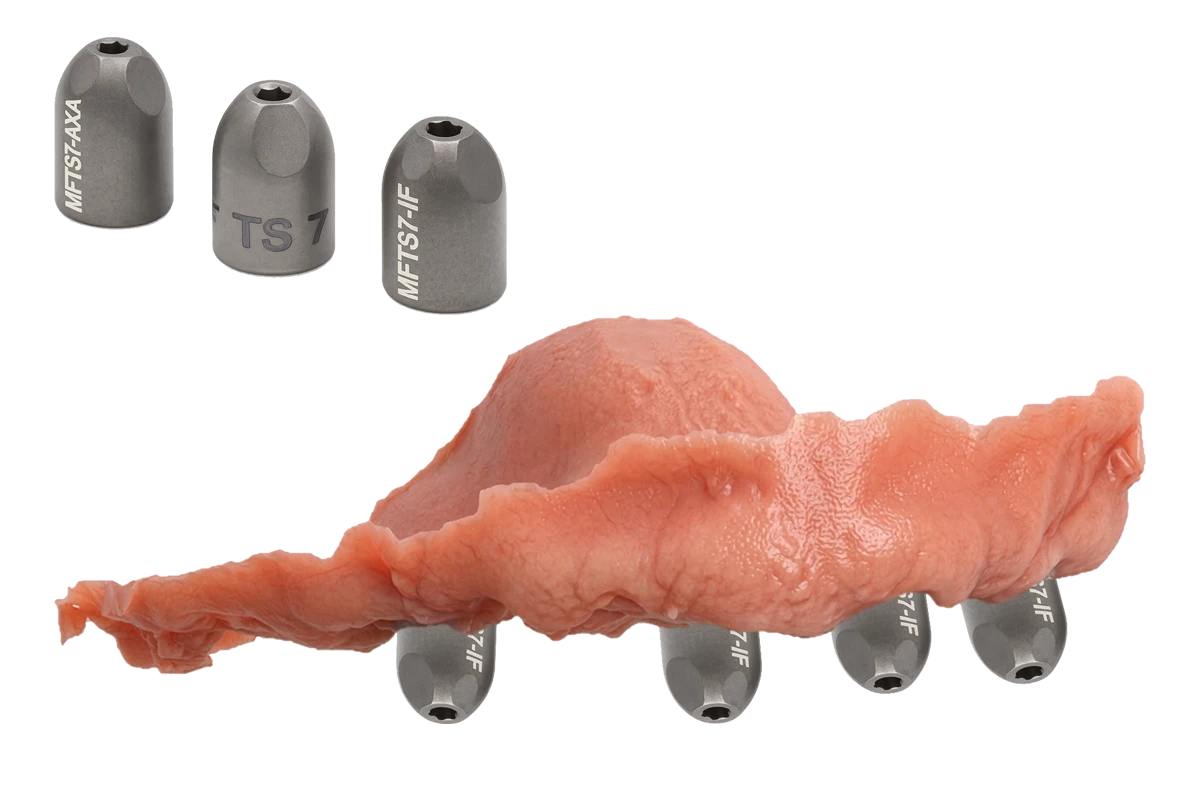
MFTS7-IF MF Tissue Shaper
This is a high-precision intelligent scanbody and an essential component of the Pdental protocol. It combines scanning, model correction and tissue shaping in a single device, simplifying the clinical workflow and supporting more stable biological integration.
Compatibilities:
- MTFS7-IF. Multi-unit (Nobel)
- MTFS7-ECK. Multi fix (Eckermann)
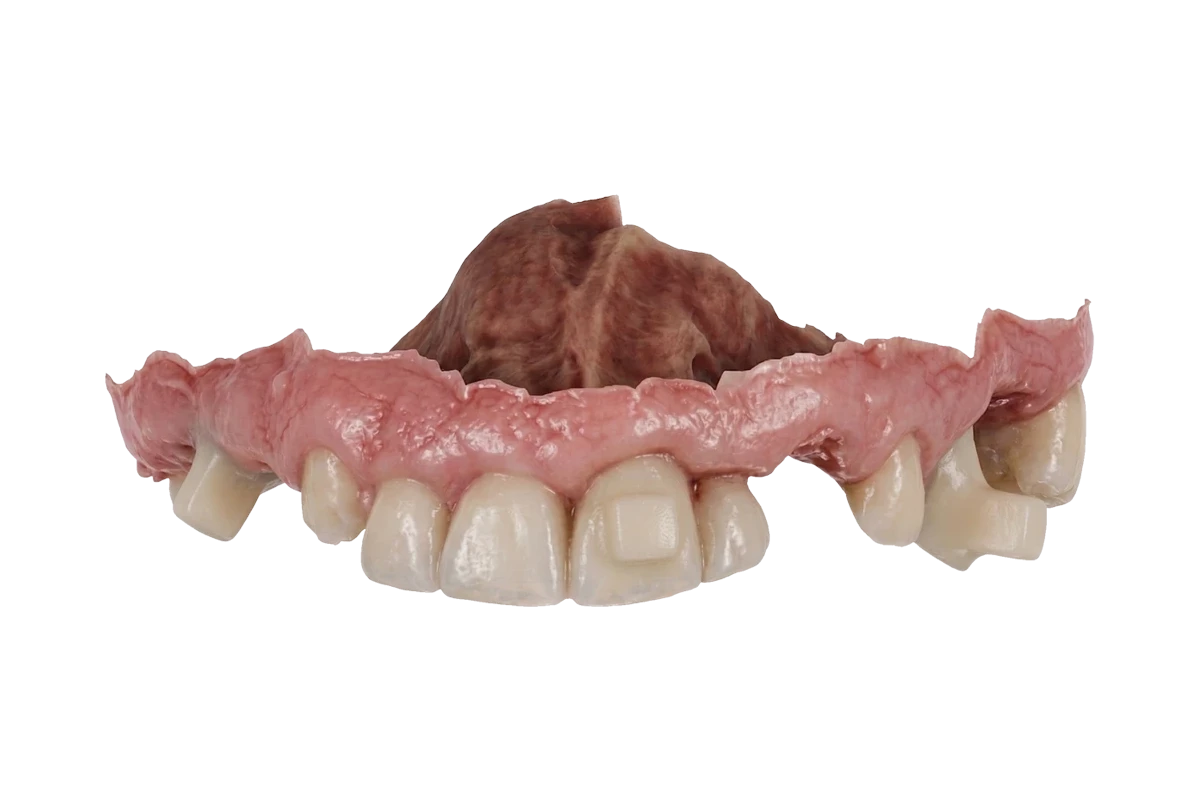
MFPDL Medicalfit Pdental Links
They are radiopaque locators used in the patient’s pre-operative models to accurately register the initial situation and connect it to the prosthetic planning.
From ideal planning to immediate provisionalisation
One of the main challenges in implant-supported rehabilitation is connecting pre-operative planning, carried out calmly and under control, with the clinical urgency that arises after surgery.
Pdental is capable of linking the patient’s pre-operative situation with the information obtained after the intervention, generating a corrected and passivated foundation on which the clinician can work with speed and confidence.
This makes it possible to obtain a valid STL file for manufacturing a provisional through printing or milling in just a few minutes, reducing turnaround times and bringing greater reliability to the process.
Competitive advantages of Pdental
MF Tissue Shaper streamlines the workflow by combining scanning, registration and tissue shaping in a single device. This reduces tissue trauma, simplifies the clinical procedure and helps create a more stable peri-implant environment for immediate loading, while improving comfort during prosthesis placement.
By bringing the entire process together in a single workflow, it replaces multiple components and reduces both the learning curve and the risk of errors. The result is an easy-to-implement solution that enhances patient experience and improves clinical profitability.
Medicalfit combines intraoral scanning and CBCT to verify the actual fit through automated processing. Its 3D viewer makes it possible to pinpoint the source of any error with precision, turning digitalisation into a complete audit tool.
The Medicalfit 3 High Speed line dramatically shortens turnaround times, making it possible to deliver the V1 provisional in just 1–2 hours. It is designed to provide true immediacy without compromising the quality of the clinical workflow.
Medicalfit offers an ecosystem that connects clinic and laboratory through CAD design and 3D printing. This turnkey workflow supports both full adoption and flexible integration into existing structures.
The solution integrates into the existing infrastructure without requiring major investment in capture equipment. By enhancing the current workflow rather than replacing it, it lowers resistance to change and reduces commercial risk.
The solution is backed by patent EP2907474A1, covering radiology-based modelling for CAD/CAM workflows. This technological exclusivity protects the know-how and creates a strong barrier to entry for competitors.
It enables implant companies to accelerate their digital transition without the need for in-house development. By adopting this protocol, they can strengthen their position in immediate loading with a faster workflow and fewer complications.
Its value lies in transforming a traditionally artisanal process into an industrialisable, defensible and highly profitable model. It responds to the global demand for immediacy with a solution that is strongly aligned with today’s market needs.
Designed for professionals who need precision without slowing down the clinical pace
Pdental is intended for dental clinics and professionals working with advanced implantology, full-arch rehabilitations and immediate loading protocols who are looking for a tool that delivers greater control in less time.
It is especially suitable for teams aiming to:
- Optimise their digital protocols.
- Improve the reliability of implant-supported design.
- Reduce provisionalisation times.
- Work more safely in full-arch cases.
- Move towards a more automated and scalable model.
Easy access through Dentalreply
Pdental is accessed through Dentalreply, a collaborative platform designed to allow different companies to coexist within the same dental technology ecosystem.
This environment facilitates the exchange of services, improves process efficiency and makes it easier to incorporate advanced solutions such as Pdental into a connected, agile and quality-driven clinical workflow.
Request more information
Discover how Pdental, as an automatic passive fit dental software, can help you improve precision, streamline immediate loading workflows and generate a corrected virtual patient ready for design.

